Endpoint Security
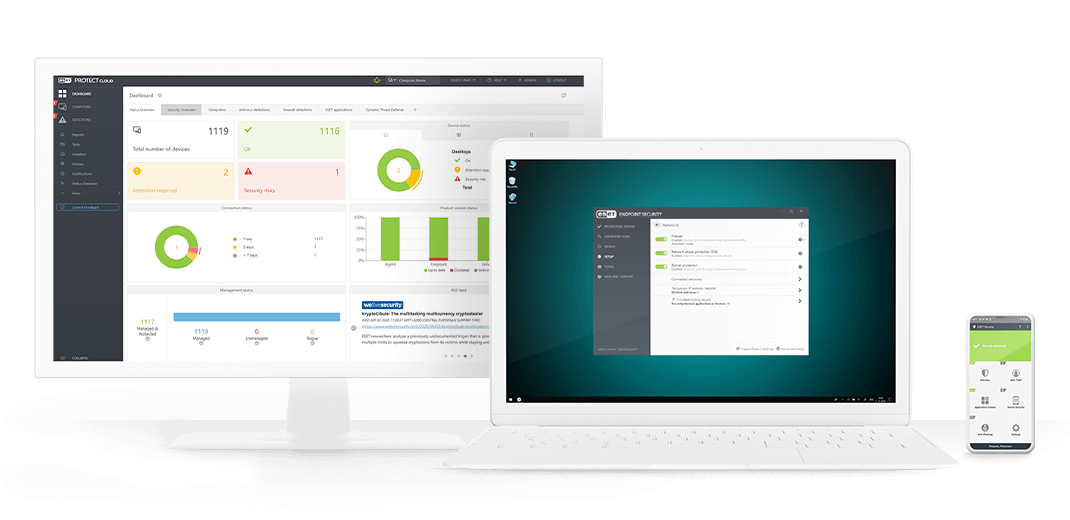
ESET PROTECT is a comprehensive, cloud-managed security platform designed to protect modern businesses against today’s evolving cyber threats. It provides advanced endpoint protection, threat detection, and centralised visibility across devices, users, and workloads — all from a single management console.
Built on proven multilayered security technology, ESET PROTECT combines antivirus, anti-ransomware, behavioural detection, and advanced threat defence to stop known and emerging threats before they impact your business. Real-time monitoring, automated responses, and detailed reporting give organisations the insight and control needed to maintain a strong security posture.
With flexible deployment options and lightweight agents, ESET PROTECT supports hybrid and decentralised working environments without compromising performance or user experience. It enables businesses to enforce consistent security policies, meet compliance requirements, and respond quickly to incidents — whether systems are on-site, remote, or in the cloud.
Your organisation needs to comply with a complex and ever-widening matrix of cyber and data security rules and regulations. Compliance is necessary for legal reasons, in order to safeguard your users, customers and employees, and to allow you to access cyber insurance products.
ESET cyber and data security solutions are designed to help you achieve all these aims.
Knowing compliance is a top priority. ESET gives you confidence that you have secure, efficient and compliant operations with solutions that address industry frameworks and keep up-to-date with the changing regulations.
- Modern Endpoint Protection
- Modern Threat Defence
- Full Disk Encryption
- Modern Endpoint Protection
- Modern Threat Defence
- Full Disk Encryption
- Cloud App Security
- Vulnerability & Patch Management
all prices are subject to VAT at 20%
Cyber Security Compliance for Business

Cyber Essentials is the UK Government’s minimum baseline standard for cyber security for organisations of all sizes. The annually renewable certification scheme is aligned to five technical controls designed to prevent the most common internet-based cyber security threats.
We recommend that once reviewing the requirements document, you proceed to complete the Readiness Tool questionnaire, this will provide you with an anonymous assessment of your organisation, in turn highlighting any areas in which practices should be improved.

The verified self-assessment questionnaire of Cyber Essentials is a prerequisite to Cyber Essentials Plus.
Although based on the same technical requirements, Cyber Essentials Plus includes a technical audit of your IT systems to verify that the controls are in place. In this way, it gives more assurance that you are complying with the scheme.
The audit covers a representative set of user devices, all internet gateways, and all servers with services accessible to the internet.
Secure Your Emails with SPF, DKIM & DMARC
Protect your business from email spoofing, phishing attacks and domain abuse with professional SPF, DKIM and DMARC configuration from Tamric.
Email remains the number one attack vector for cybercrime. Without proper authentication in place, criminals can impersonate your domain, damage your reputation, and trick customers or staff into sending money or credentials.
We help UK businesses lock down their domains, improve email deliverability, and prove their messages are legitimate.
Ideal for:
-
Businesses using Microsoft 365 or Google Workspace
-
Companies sending invoices or sensitive documents by email
-
Organisations running marketing platforms (Mailchimp, HubSpot, etc.)
-
Any business concerned about phishing or impersonation
-
Firms struggling with emails going to spam
Common signs you need this service
-
Customers report suspicious emails from “you”
-
Your emails go to junk folders
-
You’ve failed a Cyber Essentials audit
-
Microsoft or Google warns your domain is not authenticated
-
You’re setting up a new domain or migrating email platforms
What are SPF, DKIM & DMARC?
These three standards work together to verify that emails sent from your domain are genuine:
SPF (Sender Policy Framework)
Defines which mail servers are allowed to send emails on behalf of your domain.
DKIM (DomainKeys Identified Mail)
Adds a cryptographic signature to your emails so receiving servers can verify they haven’t been altered.
DMARC (Domain-based Message Authentication, Reporting & Conformance)
Tells receiving servers what to do if SPF or DKIM fail and provides reporting so you can see who is sending mail using your domain.
When configured correctly, they form a powerful defence against impersonation and fraud.
